A-Grade Uji Matcha in Brooklyn.
Uji, Kyoto is Japan's most prestigious matcha region, where the tea ceremony began 800 years ago. A-Grade is the top classification. Café Mia in Bushwick serves it as our house standard.
Uji, Kyoto is Japan's most prestigious matcha region, where the tea ceremony began 800 years ago. A-Grade is the top classification. Café Mia in Bushwick serves it as our house standard.
1128 Broadway, Bushwick · Open daily 8 AM – 5 PM
A-Grade Uji matcha from Kyoto, Japan, the top classification of matcha's most prestigious origin, served at Café Mia in Bushwick, Brooklyn.
Uji matcha is the most prestigious matcha in the world. Grown in Uji, Kyoto, Japan's oldest and most respected matcha region since the 12th century, it's what Japanese tea masters have used for the tea ceremony for over 800 years. A-Grade denotes the top single-origin classification within Uji. It's what we use at Café Mia, and it's the reason our matcha tastes like real tea instead of like a green-flavored drink.
Uji sits in the hills south of Kyoto. The region's specific combination of morning fog, humidity, calcium-rich soil, and a 800-year cultivation tradition produces tea leaves that no other Japanese region has fully replicated. When you shade-grow those leaves for 3–4 weeks before picking (as ceremonial-grade matcha requires), then stone-grind them to powder, you get a matcha with three qualities that generic ceremonial matcha lacks:
Within Uji itself, matcha is graded by leaf quality and processing precision:
A-Grade Uji at the source in Kyoto sells for the equivalent of $80–$120 per 30g. That's why it's rare in American cafes, the wholesale cost pressure pushes most shops down to standard ceremonial-grade or below.
The simplest test: order a matcha shot. 2g whisked in 2oz of hot water, no milk, no sugar. Café Mia's shot is $4. Compare it to a generic ceremonial-grade matcha shot at another cafe. You'll notice three things:
Once you've experienced Uji's depth, other ceremonial matchas will taste flat by comparison. This is the difference we're trying to communicate.
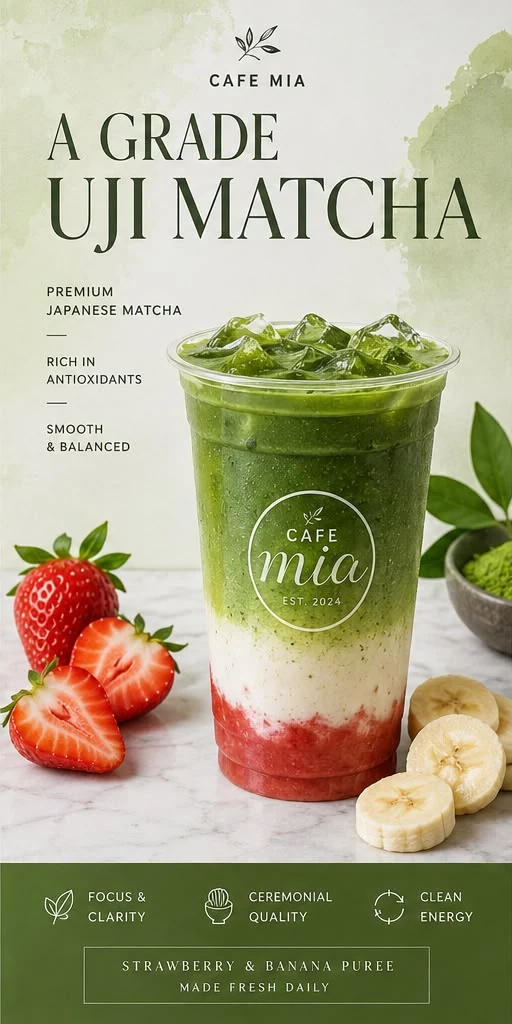
A-Grade Uji matcha, 4g dose, whisked fresh with oat milk over large-cube ice. Our #1 seller.
Real dragonfruit puree layered with A-Grade Uji matcha. Naturally sweet, vividly pink.
Fresh-squeezed lemonade meets whisked Uji matcha. Summer bestseller.
We sell take-home tins of A-Grade Uji matcha at the counter for $60. That's meaningfully below the specialty-tea-shop retail price for the same grade, because we buy at cafe volume and pass through the price. If you've been making matcha at home with a grocery-store powder, upgrading to A-Grade Uji is one of the largest single flavor jumps you can make in your kitchen.
Uji matcha is matcha grown in Uji, a city in Kyoto Prefecture, Japan. Uji has been Japan's most prestigious matcha-producing region since the 12th century, the birthplace of Japanese tea culture. Uji matcha is characterized by its intense umami depth, minimal astringency, vivid green color, and long finish. It's what Japanese tea masters use for chado (the tea ceremony). Not all matcha from Japan is Uji matcha, much cheaper matcha is grown in other prefectures or blended. Uji is a specific origin classification, similar to how Champagne is specific to a French region.
A-Grade is the highest single-origin classification within Uji matcha. It denotes matcha made from the top pick of the first spring harvest of shade-grown tea leaves, stone-ground to a fine ceremonial-grade powder. A-Grade Uji matcha is the tier used in traditional Japanese tea ceremonies. Below A-Grade you have ceremonial-grade Uji (still excellent), then premium blends, then culinary. A-Grade at the origin, in Japan, retails for the equivalent of $80–$120 per 30g tin, which is why most American cafes don't serve it.
Café Mia at 1128 Broadway in Bushwick uses A-Grade Uji matcha as our house standard. To our knowledge we're one of a small handful of Brooklyn cafes doing this rather than serving a blended ceremonial or a lower-grade Japanese matcha under the general 'ceremonial' label. Come try the matcha shot ($4), it's the cleanest way to taste Uji's depth without milk in the way.
Depth and length. Regular ceremonial-grade matcha (which can come from various Japanese prefectures or be a blend) tastes clean, bright, and slightly sweet. Uji matcha tastes clean, bright, slightly sweet, AND has a savory umami depth and a long finish that lingers 30+ seconds after the sip. Once you've had A-Grade Uji, other ceremonial matchas can taste one-dimensional in comparison. Uji is what makes matcha taste like tea rather than just green-flavored milk.
For a daily latte, it's a $0.50–$1.00 upcharge over generic ceremonial matcha at wholesale, so if your cafe uses it, you're getting a real premium for a small price bump. As a customer, this is one of the highest value-per-dollar upgrades in specialty coffee/tea culture. For take-home tins, A-Grade Uji runs $60–$100 for 30g in the US market, a meaningful commitment. For a $5.50 latte at Café Mia, you're getting the A-Grade Uji experience for less than most Manhattan cafes charge for generic ceremonial matcha.
Three reasons: (1) cost, Uji matcha wholesale runs 30–50% higher than generic ceremonial, and cafes optimize for margin; (2) supply, A-Grade Uji is only harvested in one Japanese region once a year, so supply is genuinely constrained; (3) marketing, most customers don't know Uji as a category, so cafes don't get credit for using it. We use it because it's better, and we tell you about it because A-Grade Uji is what makes our matcha distinctive.
Café Mia, 1128 Broadway, Bushwick, Brooklyn. Open daily 8 AM – 5 PM. Two minutes from the J/M/Z at Kosciuszko Street.